Page 1 of 1
German Apple II+ clone with 2 keyboards
Posted: 01 Sep 2017, 17:44
by JohnZD
I just picked up an Apple II+ clone with a defective PSU, a very nice amber monitor and two keyboards.
One of the latter is named 'Operator' and seems to sport some kind of Cherry switches with double shot keycaps.
I will recap the PSU and the rest of the mainboard tonight and see if the thing does fire up.
Has anyone seen this kind of switch before? I couldn't find anything remotely similar in the wiki.
The cherry-like board has a linear feel, slightly firmer than a brown MX, but very smooth.
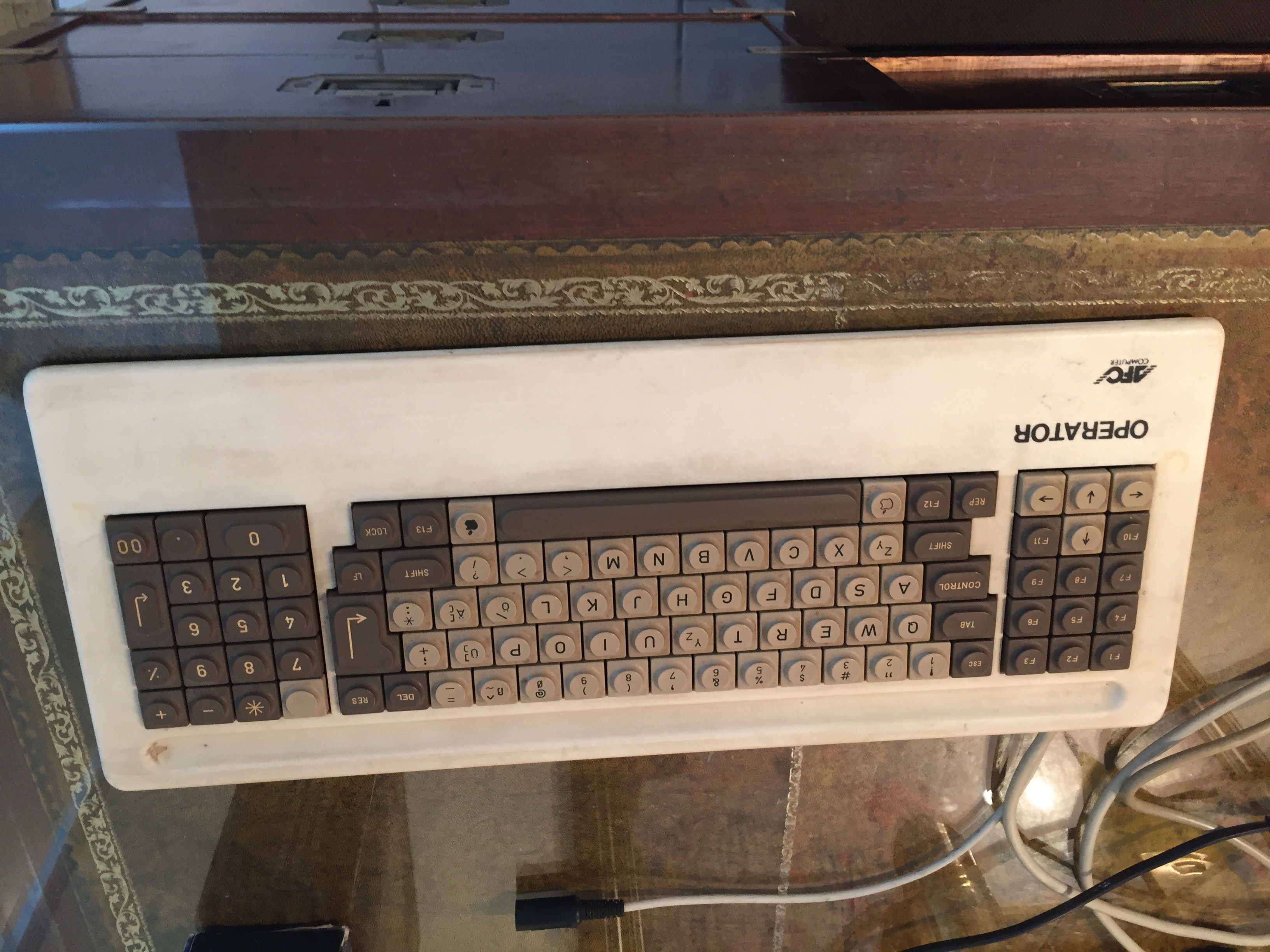
- Cherry KB
- image.jpeg (2.02 MiB) Viewed 5627 times
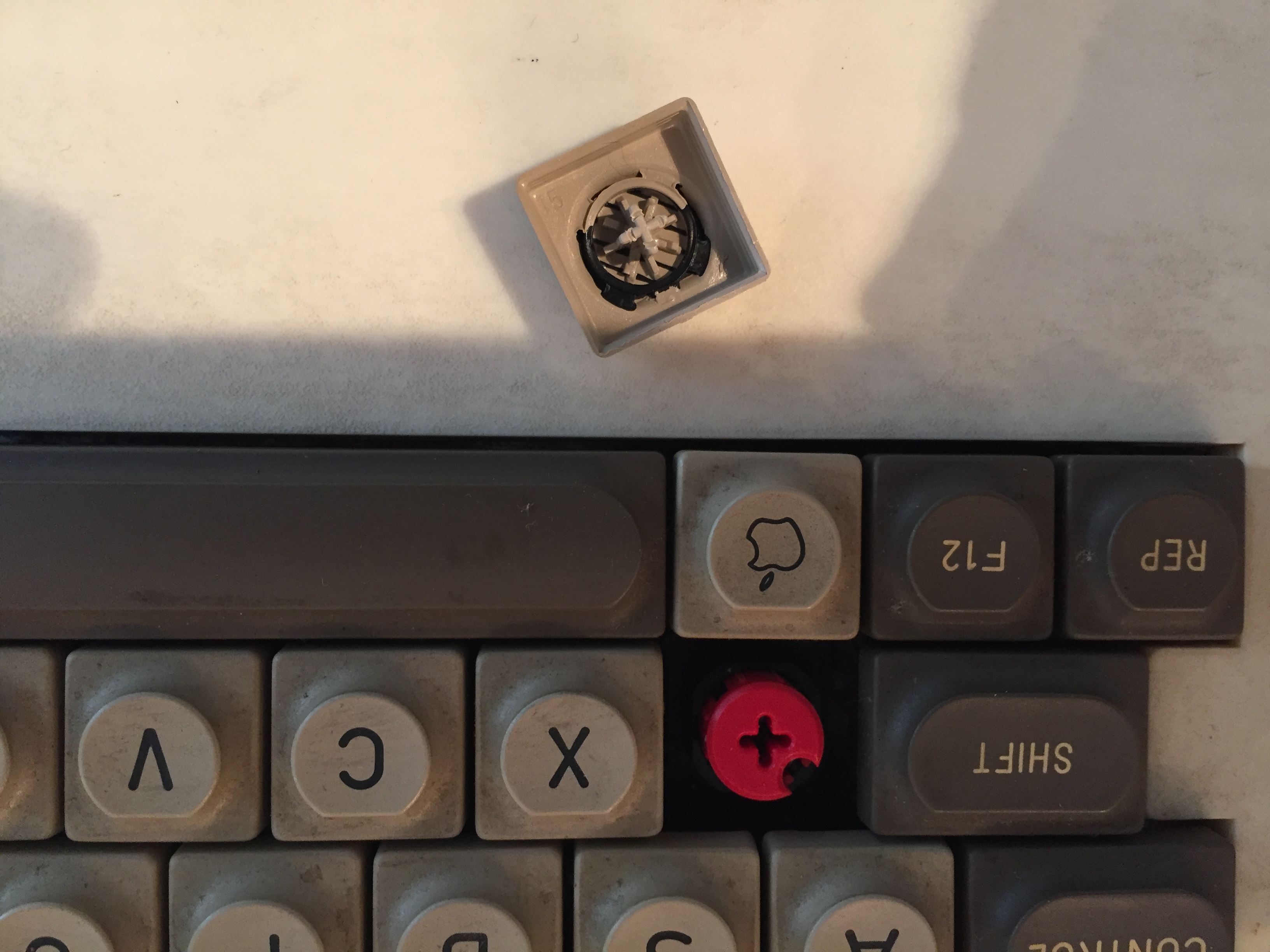
- Closeup
- image.jpeg (1.47 MiB) Viewed 5627 times
Posted: 01 Sep 2017, 22:38
by Daniel Beardsmore
Is the town/city of manufacture given? I'm guessing East Germany, as I don't think West Germany would get away with ripping off Apple like that. In which case, it could be anything from the Soviet era. The Cherry-like switches could be ИЗОТ for example, especially if they are M9-like or M8-like (both of which ИЗОТ cloned).
Whatever those red switches are, they look a bit suspect to me. It's hard to tell, but they do appear to be flat base assemblies, rather than a single moulding. I can't see any sign of a PCB though. You should remove a group of keycaps, or open up the keyboard — the PCB may be branded.
The keycaps are reminiscent of Siemens but the shape is different.
Posted: 08 Sep 2017, 11:44
by Nuum
Posted: 08 Sep 2017, 19:13
by seebart
Highly interesting thanks for the information JohnZD & Nuum! Also reminds me of RAFI in some ways.
Posted: 23 Sep 2017, 20:21
by vometia
The strange keycaps remind me of something Adler made in about the mid '80s, I think some sort of home computer, but other than that extremely vague memory I'm afraid I don't recall anything useful.
Posted: 23 Sep 2017, 20:27
by Nuum
Do you mean the Triumph Adler Alphatronics series? They have the same keycaps as some of their typewriters, but in white/off-white instead of dark brown:
(Shameless plug of my own board with those TA typewriter keycaps)
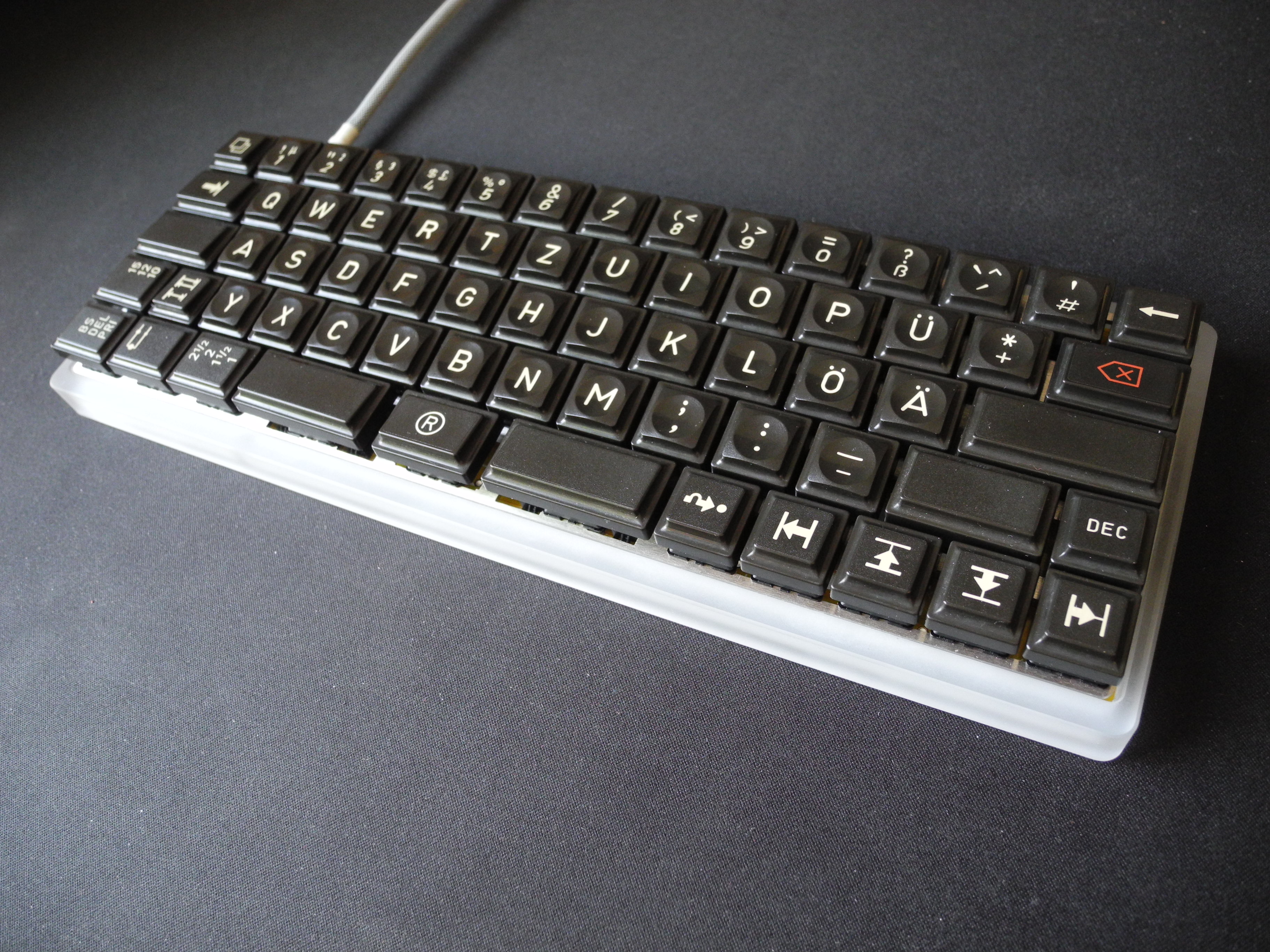
- DSCN4414.JPG (2.14 MiB) Viewed 5365 times
Not too similar, I'm afraid.
Posted: 23 Sep 2017, 21:45
by vometia
Oh, yeah, that'll be the one! I honestly couldn't remember a thing about it other than it being cream and orange and the reviewer liking its keyboard.
Re:
Posted: 21 Apr 2025, 16:08
by cyberfritz
Nuum wrote: 08 Sep 2017, 11:44
Ha, I know this board, I have the same one in my possession, albeit with different keycaps. I even have the manual, which identifies the manufacturer as AFC from Cologne and the keyboard name as 'Operator'. As far as I can tell this keyboard is from 1983.
The manual tells the user how to connect it to their computer, since this keyboard was made for a multitude of different systems. The numpad and the F keys apparently can be programmed freely by reprogramming the EPROM, it says that text macros are also possible.
...
I look for the manual to this keyboard for a long time. I got a (serial) version of it for the "Gepard Computer", and a friend of mine (a parallel) one for the Apple II.
Would it be possible to have a scan of the Operator manual?
Re: German Apple II+ clone with 2 keyboards
Posted: 23 Oct 2025, 16:44
by McKoy61
Unfortunately, I can’t help with a manual, even though I was once the author of it. The OPERATOR keyboard was the smaller sister of the ALPHAKEY keyboard, both developed by AFC Computer in Cologne and manufactured between 1984/85 and around 1988.
The key modules were supplied by Schoeller Electronic Systems and, unlike the ALPHAKEY, did not use individual Siemens switches. At the time, this was called a membrane keyboard – a mechanical key frame mounted on a switch film, which made it much more affordable to produce.
The keyboard existed in several versions:
• OPERATOR I – with functions permanently programmed into the EPROM,
• OPERATOR II – with keys that could be programmed directly by the user (EEPROM), and
• OPERATOR IIe – a special version for the Apple IIe, featuring the Apple key and a switching function for the screen character set.
An additional port allowed the connection of barcode and magnetic card readers, which could then be used as keyboard input in all programs without any further adaptation.
Depending on the version, the OPERATOR was sold for about 400–700 DM, making it considerably cheaper than the larger ALPHAKEY, which cost between 1200 and 1600 DM.
The directly programmable versions had a PRG key. To program a key, you pressed PRG, then the key to be programmed, followed by the desired key sequence, and finished again with PRG.
You can find a German manual for the ALPHAKEY — which I also wrote at the time — here:
 https://archive.org/details/alphakey-ii ... ch-deutsch
