Speculation/analysis of beam spring and cap buckling spring

User avatar
bhtooefr

23 Apr 2012, 17:02

So, beam spring is one of those "exotic" switches that many people here haven't used, but there has been much discussion about.

It is the switch that IBM intended to replace their common Selectric-based terminals, providing tactile key feel and relatively low force. It's a fairly complex switch, with three springs, and quite a few moving parts. Supposedly, it's quite durable in use, but it can be quite fragile to work with, and it's certainly costly to assemble.

Buckling spring came into production about 8 years later, as a lower cost replacement for beam spring. Overall force was increased from 55 g (according to patent GB1363777, originally filed in the US (and presumably rejected) 1971-09-24) to about 70 g (according to patent US4118611, originally filed 1977-08-30). However, initial force was reduced from 45 g to 30 g. The tactile event was also enlarged - immediately after the tactile event, a beam spring is rated at 45 g, for a 10 g reduction in force, versus capacitive BS at 50 g, for a 20 g reduction in force - doubling the tactile feel.

For the sake of completeness, here are the beam spring and capacitive buckling spring force graphs:

Beam spring:
Image

Buckling spring:
Image

This is actually much closer to how a Selectric key feels, although the Selectric also has some elements that make it more similar to a Cherry MX Blue in ways.

In any case, I have reason to believe that beam spring was merely a stop-gap until buckling spring was ready for production.

See, 4118611 was not the original buckling spring patent - it was merely an enhancement of US3699296, filed 1971-05-21 - that's right, BEFORE the beam spring patent.

This patent is on the original spring contact form of BS, which was never produced. However, the force graph shown (which isn't measured in units) shows extremely low initial force ramping quickly to a high peak, and then a very sharp tactile event. Preload on the spring is 25 grams, so we do have an EXTREMELY low initial key force, but no other figures are given. Good key feel and hysteresis are mentioned as reasons for the design of this switch, along with durability and simplicity. However, we know that this technology was never produced - presumably, spring contact was too unreliable, and the other suggestions for making it work (capacitive sensing ala Topre, piezoelectric sensors detecting the impact, or optical sensing) would likely have been too expensive.

This switch, however, sounds like what IBM and Richard Hunter Harris were really going for. Beam spring was produced because it was possible with the technology available at the time (the capacitive BS switch requiring a lot of fine tuning on the injection molds that beam spring did not need), and it was still a lot cheaper than using Selectric mechs like IBM was doing. But, buckling spring offered lower initial force (which I find is an important part of reducing fatigue), sharper tactility, and lower cost once the alternate method of actuation that IBM ultimately used was found.
Last edited by bhtooefr on 23 Apr 2012, 17:40, edited 1 time in total.

User avatar
Icarium

23 Apr 2012, 17:28

Which is which in the diagrams?

User avatar
webwit
Wild Duck

23 Apr 2012, 17:32

Interesting theory. I have two points to argue against it: first you could make the same argument about rubber domes, that it is a planned IBM improvement on switches (that in this case make less sound), while it is just about making things cheaper. Before the PC, the typewriter ruled. The key feel and print where the main drivers. It was about the keyboard, the quality of the key feel sold typewriters, so they went for the best key feel. The beam spring is the continuation of this in computer keyboards. And the keyboard did not need to be cheap, because they were a tiny amount of the huge overall cost of hardware. But in the Eighties with the rise of the PC, they needed a cheaper solution, in a field where price started to get more important, and PCs weren't bought for the keyboard, but for the cpu, memory, display and software. My point being that buckling springs are just cheaper and a compromise between cost and quality.

Second point is about the tactile event. You're comparing a heavy and a light switch (mine actuate at 50g btw, lighter than the patent) by tactile event, I'm not sure if you can do that. I could theoretically invent a 100g switch, and then say it's the best because of its 40g tactile event. Do you see my point? I love the tactile feel of BS, the only downside is that I would have loved it more with 15-20g less force needed. I think its an inherent limitation of the BS (and hence of making things cheaper), it needs that force for faultless operation. I don't think they designed the switch to get a different tactile feeling. My speculation is that one of their goals was to get it as close as possible to Selectric - here too it boils down to the consequence of the balancing of the other factors (simplicity, price).

User avatar
Icarium

23 Apr 2012, 17:39

Just because somebody has to ask the questions for the dumb people:

What kind of switches are we discussing here:
1. Beam spring
2. Buckling spring
3. Whatever the selectric has?

Bleagh, this is confusing.

User avatar
webwit
Wild Duck

23 Apr 2012, 17:41

Yes, all of the above!

User avatar
bhtooefr

23 Apr 2012, 17:46

We're discussing beam spring, contact buckling spring (which was never produced) at the end, capacitive buckling spring, and all of this in relation to the Selectric's mechanism to an extent.

And, I am comparing a heavy and a light switch, yes, although I'll note that the heavy switch has a lighter initial force, which I find is one of the more critical measurements to determine whether I'll find a switch fatiguing - a 50 g linear with 45 g initial force will tire my fingers out sooner than a 75 g tactile with a 20 g initial force, for example.

That said, one of my main arguments is that buckling spring actually came BEFORE beam spring. I'm unaware of any rubber dome designs by IBM from that time period. ;)

ripster

23 Apr 2012, 19:04

Selectric is about 60g but the feel is quite different than any computing keyboard. I think the whole "IBM Selectric Feel in a Model M" thing is wikipedia bs. They believed IBM's Marketing Department.

Good reminder to fire up the ol' selectic today. Otherwise the grease turns into glue.

User avatar
daedalus
Buckler Of Springs

23 Apr 2012, 19:34

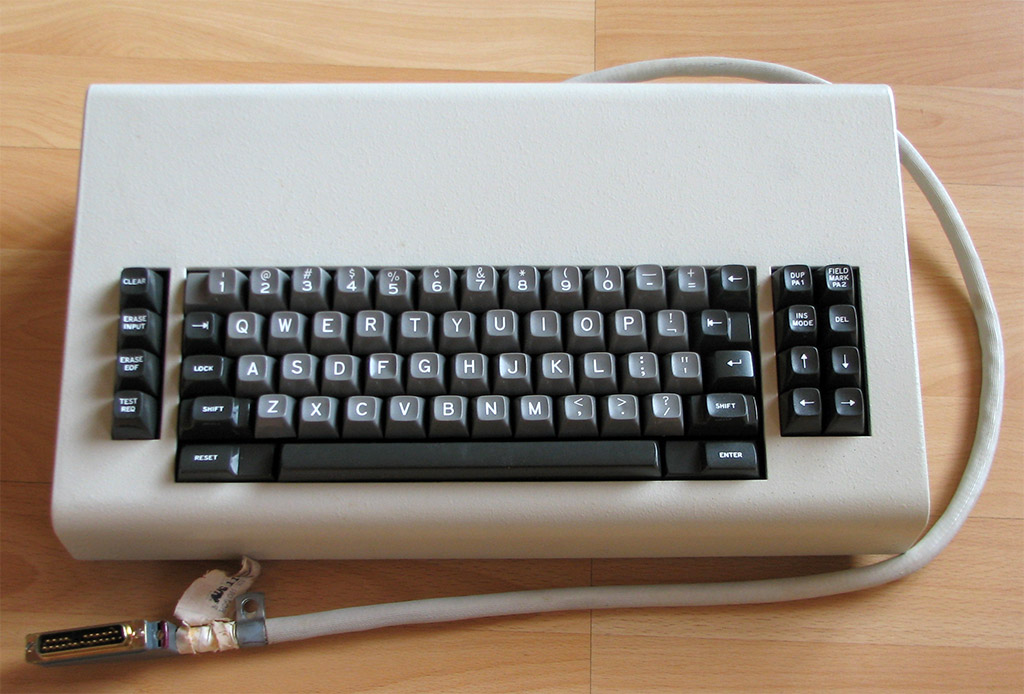
According to this IBM announced the 3270 series (complete with the 3277 terminal which used the pictured keyboard) a few weeks before those patents were filed, with demonstrations come not long after. Now, IBM being IBM, that sort of stuff wouldn't have come out of thin air, so the Beam Spring probably dates back to the late 1960s. It's certainly a half way house between a typewriter mechanism and a modern keyboard switch...

Image

(Mhmm, I'd seen a picture of a German one of those lately where the stepped keys were stretched instead... late production model? Those things were made well into the 80s/90s)

Image

EDIT: Actually, the gloss and font are all wrong.... very early clone?

Image
Image

Casing looks legit, but those keys seem wrong... the RESET and ENTER keys stick out too much, at least compared to the 3278 board I have. Again, could be some very early or late production model stuff.

User avatar
webwit
Wild Duck

23 Apr 2012, 23:03

Which patent came first doesn't say anything by itself if you don't know reasons and motivation. I don't think they started with a wanted, superior force diagram, and then implemented a buckling spring for it. I think they researched tactile buckling springs, you get this kind of force diagram, and they patented it. This is speculation of course, but so is any other conclusion you draw from it.

User avatar
bhtooefr

24 Apr 2012, 00:50

That is one thing that I'd like to see happen (and possibly do) - interview Richard Hunter Harris.

Actually, I've got ideas for a documentary (think in the style of Jason Scott's documentaries) covering the buckling spring keyboard. You could get quite a lot done just interviewing two people - Richard Hunter Harris, and Neil Muyskens.

User avatar
daedalus
Buckler Of Springs

24 Apr 2012, 01:11

There is also Edwin Coleman, the guy behind the Model M. That said, his contribution was more likely the membrane as opposed to anything to do with the keyswitch mechanism.

User avatar
webwit
Wild Duck

24 Apr 2012, 03:09

Those IBM guys have been awfully quiet. I've never seen a single ex-IBM guy on the forums. They either were buried with the factories like slaves with the pyramids, or they aren't very well connected. Or they really don't care. Come out, come out, wherever you are.

User avatar
Icarium

24 Apr 2012, 09:46

bhtooefr wrote:That is one thing that I'd like to see happen (and possibly do) - interview Richard Hunter Harris.

Actually, I've got ideas for a documentary (think in the style of Jason Scott's documentaries) covering the buckling spring keyboard. You could get quite a lot done just interviewing two people - Richard Hunter Harris, and Neil Muyskens.
That would be awesome. I love his documentation on IF. Then again I know most of the people he interviewed. ;)

User avatar
daedalus
Buckler Of Springs

24 Apr 2012, 13:28

Judging by recent patents, Mr. Harris is more interested in making printer parts these days. I guess it came with the territory given that all that stuff was done by one arm of IBM.

User avatar
bhtooefr

24 Apr 2012, 15:27

Continuing the discussion of the documentary here: http://deskthority.net/keyboards-f2/any ... t2519.html

User avatar
Peter

24 Apr 2012, 16:36

webwit wrote:Those IBM guys have been awfully quiet. I've never seen a single ex-IBM guy on the forums. They either were buried with the factories like slaves with the pyramids, or they aren't very well connected. Or they really don't care. Come out, come out, wherever you are.
Or, they are under a 'Non-disclosure 'agreement' ' ....
My IBM-friend has been retired for A LONG TIME and you know what ?
They STILL pay, monthly, to the pension-fund that he,his ex-wife and IBM set up !

User avatar
webwit
Wild Duck

24 Apr 2012, 16:42

Yeah I know a guy like that... got retired early in one of those firing-rounds. Peak oil bastard. Now he claims to be a stock expert... he got it all!

User avatar
Peter

24 Apr 2012, 17:00

webwit wrote:Yeah I know a guy like that... got retired early in one of those firing-rounds. Peak oil bastard. Now he claims to be a stock expert... he got it all!
Actually, he retired when he was sixty-two.
That seems to be normal procedure in Big Blue .
I'm not really sure what it is you are trying to say ..

But, 'Screw You' Webwit ..
I'm fed up with all your BullShit .

User avatar
kps

24 Apr 2012, 17:11

Model F buckling spring switches bottom out immediately after the click — they are nothing like Selectric keys.

User avatar
bhtooefr

24 Apr 2012, 17:32

I know, but they could have been going for something resembling Selectric.

(Actually, beam spring bottoms out even closer to the click, IME.)

User avatar
daedalus
Buckler Of Springs

24 Apr 2012, 17:37

I find it easy enough to not bottom out on Model Fs, although I have noticed its easier on my AT than my 122 key. Some have said that the XT is better still...

The Beams bottom out almost straight away after the tactility. They are dampened though, so it's not that bad.

User avatar
webwit
Wild Duck

24 Apr 2012, 17:50

Peter wrote:Actually, he retired when he was sixty-two.
That seems to be normal procedure in Big Blue .
I'm not really sure what it is you are trying to say ..

But, 'Screw You' Webwit ..
I'm fed up with all your BullShit .
Hmm, what did I do? Random attack is random. Do I know you? Also, I don't think we're talking about the same guy here buddy.

itlnstln

24 Apr 2012, 19:05

webwit wrote:
Peter wrote:Actually, he retired when he was sixty-two.
That seems to be normal procedure in Big Blue .
I'm not really sure what it is you are trying to say ..

But, 'Screw You' Webwit ..
I'm fed up with all your BullShit .
Hmm, what did I do? Random attack is random. Do I know you? Also, I don't think we're talking about the same guy here buddy.
Uh-oh...

User avatar
bhtooefr

24 Apr 2012, 19:37

He ain't your buddy, friend!

User avatar
Peter

24 Apr 2012, 19:52

Webwitt :
Yeah I know a guy like that... got retired early in one of those firing-rounds. Peak oil bastard. Now he claims to be a stock expert... he got it all!
The one I know didn't 'get retired early', hasn't got anything to do with 'peak oil', isn't 'a bastard' and doesn't claim to be
'a stock expert' .
As for 'getting it all' : He's a 'baby-boomer', didn't they all 'get it all' ?

ripster

25 Apr 2012, 02:53

Everybody calm down or I'll have to report webwit to webwit.

User avatar
daedalus
Buckler Of Springs

25 Apr 2012, 14:07

Peter wrote: Webwitt :
Yeah I know a guy like that... got retired early in one of those firing-rounds. Peak oil bastard. Now he claims to be a stock expert... he got it all!
The one I know didn't 'get retired early', hasn't got anything to do with 'peak oil', isn't 'a bastard' and doesn't claim to be
'a stock expert' .
As for 'getting it all' : He's a 'baby-boomer', didn't they all 'get it all' ?
I think this is one of those lost-in-translation situations where the scope of "I know a guy like that" is ambiguous. I don't think anyone intended to offend anyone.

User avatar
bhtooefr

26 Sep 2012, 12:59

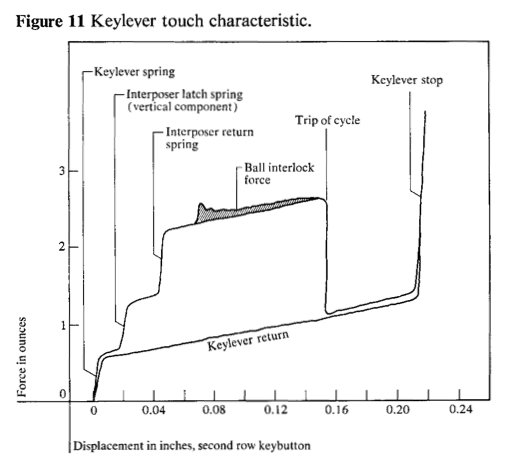
I'm gonna go ahead and necropost this thread with the Selectric Composer's force graph:

Image

Stolen from here: http://ibmcomposer.org/joomla/images/st ... yboard.pdf

I do believe that's different from a regular Selectric (I think the regular Selectric has one less spring in its mechanism) (edit six years later, I think I was wrong there), but similar. Note the zero preload. About 71 g peak, and looooooooong travel.

Post Reply

Return to “Keyboards”