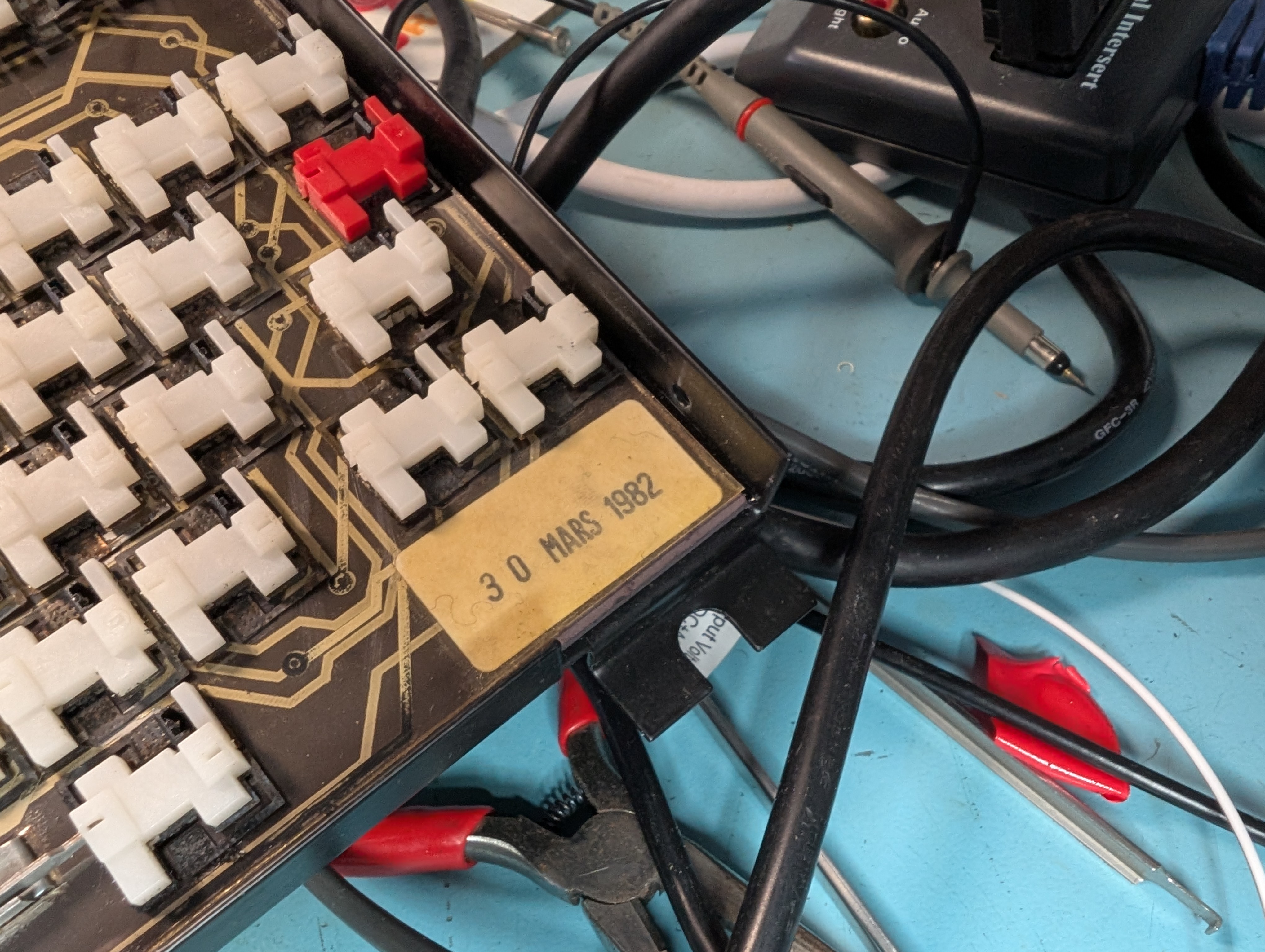
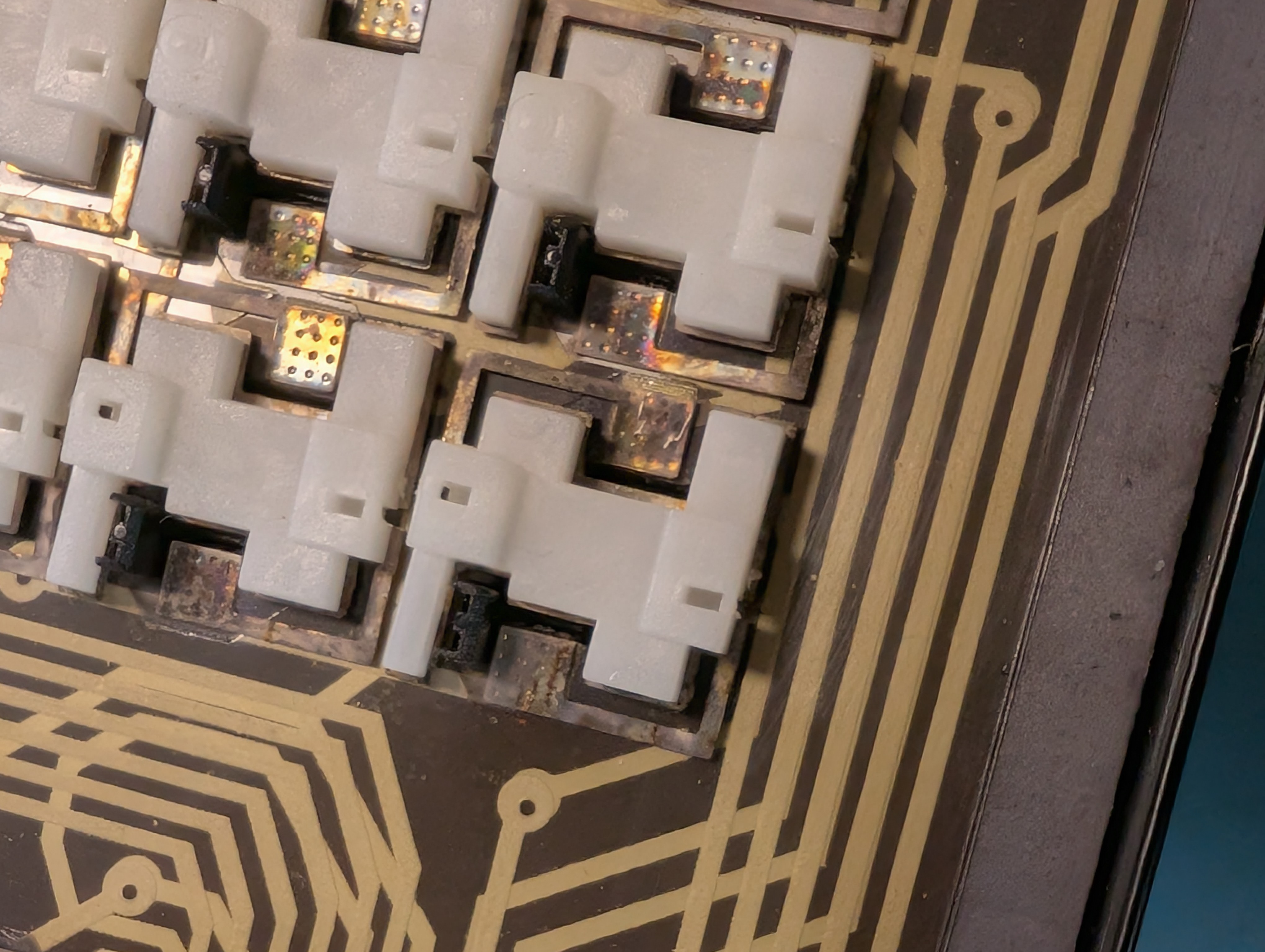
Hi all! I'm repairing an unusual machine - a French Goupil II from 1982. It's a 6800 based machine (6808 to be exact), and it's been a long process. It's now booting, but the keyboard is giving me trouble and I'm trying to understand it. I cannot get my head around how this keyswitch works!
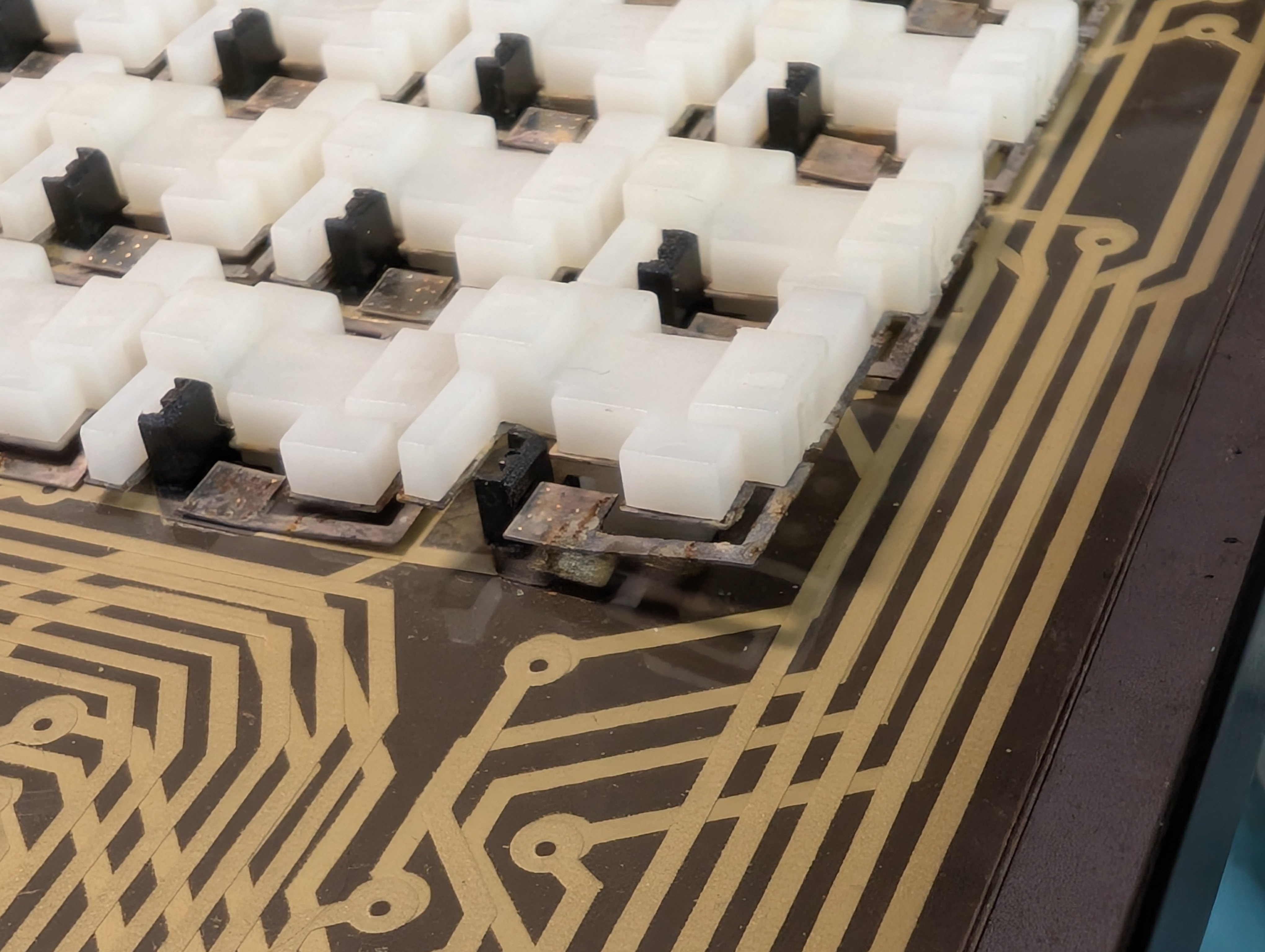
When you press a key, it lifts away from the membrane, when you release it, the two metal arms make contact with pads on the membrane. The two metal arms aren't connected, as far as I can tell with my multimeter, so my first theory (that depressing a key breaks a circuit) doesn't seem to hold up. But then, what do these arms do? Perhaps there is something happening inside the keyswitch that I can't see, and that these arms are connected to something else. Has anyone else seen a switch like this?
Many thanks in advance, Tony.
Some more pictures ...
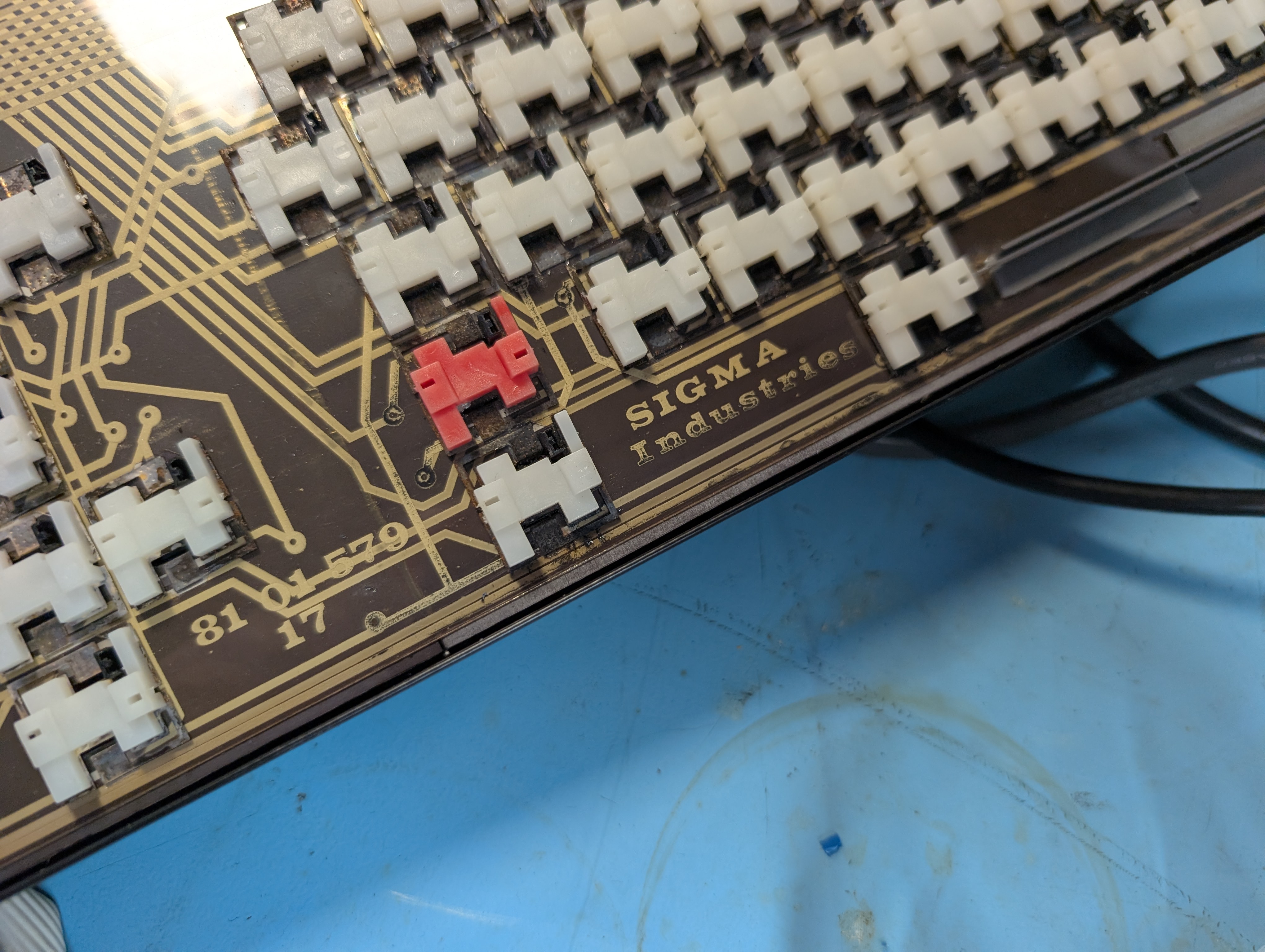
Anyone tell me how this keyswitch works? I am utterly confused
-
Coeus
- Location: United Kingdom
- Main keyboard: IBM Model F PC/XT
- Main mouse: Elecom Huge
When you say the arms are not connected, do you mean the two arms for one key are not connected to each other?
I wonder if this is capacitive.
With key switches that make contact, there is the ghosting problem, where when a number of contacts are made, current can flow to a different row/column than the one being scanned and cause other keys that are not pressed down to appear to be. There was quite a good description of this on the Wiki. This can be solved with a diode at each switch position but that adds expense and most keyboards don't have them. That makes using normally closed (connected) switches a strange choice.
Capacitive keyboard, for example the IBM Model F, don't have this problem and can detect an arbitrary number of keys down. So it could be that, while the arms are not connected at DC, there is effectively a capacitor between them, even if not a discrete component - it could be that they are in very close proximity in the plastic moulding. That way, when the key is up there is a certain capacitance between the pad and when it is down, that capacitance no longer appears.
I wonder if this is capacitive.
With key switches that make contact, there is the ghosting problem, where when a number of contacts are made, current can flow to a different row/column than the one being scanned and cause other keys that are not pressed down to appear to be. There was quite a good description of this on the Wiki. This can be solved with a diode at each switch position but that adds expense and most keyboards don't have them. That makes using normally closed (connected) switches a strange choice.
Capacitive keyboard, for example the IBM Model F, don't have this problem and can detect an arbitrary number of keys down. So it could be that, while the arms are not connected at DC, there is effectively a capacitor between them, even if not a discrete component - it could be that they are in very close proximity in the plastic moulding. That way, when the key is up there is a certain capacitance between the pad and when it is down, that capacitance no longer appears.
-
herebedragons
- Location: United Kingdom
That's a good theory! And yes, the two arms for one key aren't connected - well, certainly not in a way my multi-meter sees. Maybe that explains the little bit of extra circuitry on the keyboard controller board that had me puzzled (pictured) - the capacitors and transistor. I'm still a bit lost on how to get it working, but this gives me a different way of looking at it - thank you!